
Belonging as a Vessel
As the fresh semester commences, I get the chance once more to experience a type of ‘belonging’ that I have never experienced in any other location, in any other relationship and in any other way of being. Sometimes it feels like a burden carrying this exhausted body of myself to the classroom, after a week of meeting people and their vulnerability in my therapy room, trying to hold their pain, brokenness, suffering, anger, shame, humiliation, etc. Though as I arrive in the classroom, something shifts in me…it seems that I arrive at my healing place. I arrive to be embraced by the genuine and generous words of Socrates, by the humility of Epicurious, lit up with the Platonic hope of being released from the cage and stare into the shining sun of the world of Forms, the steady strength of the Stoics who teach me to dwell with what I cannot change. The measured balance of Aristotle, who reminds me that flourishing lies not in extremes but in the harmony of the middle path. The careful gaze of Husserl, who invites me to suspend my judgments and receive the world as it gives itself. The embodied vision of Merleau-Ponty, who shows me that perception is a weaving of self and world, never one without the other. The trembling courage of Kierkegaard, who calls me to leap into the unknown, trusting without guarantee. The scorching voice of Nietzsche, who dares me to embrace life’s eternal return, with all its suffering and its joy.
The radical attentiveness of Simone Weil, who whispers that attention itself is the purest form of love. The vigilant clarity of Hannah Arendt, who warns that the failure to think is the seed of evil. The fierce determination of Simone de Beauvoir, who insists that my freedom is bound up with the freedom of others. The ethical summons of Levinas, who teaches that the face of the Other calls me to responsibility before I can even speak. And the unsettling call of Heidegger, who brings me back to the question of Being, to dwell in its mystery and its silence. The breeze of the philosophy and Ethics class fills my lungs, sustaining me with a life that carries me as I walk on earth, and accompanies me to the therapy room. And as the class finishes and while leaving the classroom, students appreciate me as they enjoy their philosophy class, I feel a deep relief, an absolute humility that I could take these people to the meeting point where Logos unfolds, that I a faithful representative of the logos entrusted to me by Socrates, Plato, and the long line of thinkers whose words I have inherited. Their appreciation feels less like praise for me and more like testimony to the enduring power of philosophy itself.
Belonging as Masking
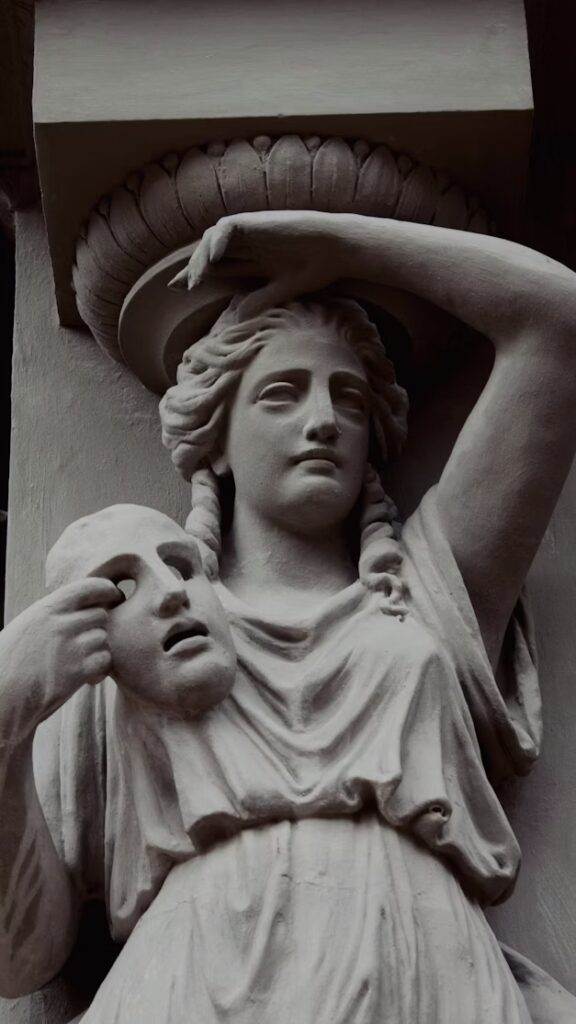
At sunset, when the world hovers in a trembling balance between light and darkness. The sun’s last embers stain the horizon, yet the night has not fully claimed the sky. In this in-between hour, as I drive home from the clinic, I am unsettled by the figure of me who appeared in the session. Not always a familiar face, but at times a blurred one; unfinished, fluid, as though the frame of the professional self had dissolved at its edges. I catch myself wondering who it was that truly sat there with the client: was it me, or only a mask? The fading light outside mirrors this ambiguity within, where identity hovers in half-shadow, not fully formed, not fully mine. I remember the deep and genuine appreciation of the client for what they called an enlightening and transformative session. And yet, just before that warm gratitude could land in me, a question rose up: “Then what? It wasn’t even you…”. Their gratitude seemed directed toward a figure I do not fully recognise, a professional self, a mask with blurred edges; and I am left wondering where I ‘myself’ had been in that encounter. Was I present at all? Was I so absorbed in carrying professional expectations, responsibility and the weight of care that I could assume the client’s gratitude was directed toward the performative mask of an attentive therapist rather than the deeper self, concealed beneath?
The gratitude for a transformative therapy session always seemed to go toward the mask of the specialist in the room and rarely reached the soul who was wearing the mask. What was going on here, what was happening to the ‘recognition’? There was a recognition involved, but recognising the mask rather than the self, concealing itself under the mask. This sense of alienness wasn’t created by the client; it was born from my own choice to exhibit the therapist mask as I believed it might be more reliable and more acceptable to them than the philosopher self it concealed. The mask, though unsettling, is not a lie or a fabrication; rather, it was a figure I stepped into so the other might feel held, so interpersonal trust can flourish. Is there a possibility at all that I can feel one with the figure… perhaps the recognition that seems to fall upon the mask would not be entirely misplaced. For beneath it, the self still lingered, trembling, present in ways that were not always visible. The mask was not the opposite of me, but a surface through which something of me, and perhaps something greater than me, could still pass.
Reframing Therapy as Logos-Carrying Work
If I ever want to feel the humility that fulfills me after each philosophy lesson, I believe that I have to be given to myself in the same manner in which I am received in teaching. When students appreciate me, I don’t feel inflated, but I feel humble, because it’s not me alone, but the tradition that I trusted to carry. Then I should ask whether therapy can be reframed the same way, where the gratitude of clients is not for “me the helper” but for the depth of the human encounter, which I was simply holding open. Can the self once again be the representative of Socratic Logos in the therapy room, where the self can practice attentive listening, questioning and helping to unveil our truth that arises in the between, in the relational field? Then the client’s gratitude belongs to the work, the process, to the human spirit and to the mystery of encounter. Then the gratitude is not for the self of the therapist alone, but for that lineage embodied in us; the lineage of phenomenology, psychotherapy, even the ethical vocation of care.
The fidelity to unfolding Logos, truth, and the living dialogue in the therapy room, in which the therapist happened to be faithful, attentive and present, brings an absolute humility. While in the teaching room, when I teach, I don’t think that I am “performing” philosophy; rather, I feel carried by the Logos, and entrusted to carry it for a while. It doesn’t belong to me, yet it passes through me, and in that passing, I become both servant and steward of something greater than myself. In therapy, the logos is the truth of lived experience, unfolding between therapist and client, while in teaching, the logos is the philosophical tradition, unfolding between the teacher and students. However, in both cases, the task is not to “do” or “own” but to be faithful, to accompany what is trying to be born. I can think of Socrates, who called himself the maieutics (Midwife of Souls): the midwife does not create the baby; they help it be born. So too, therapists, we do not cause the client’s change, but rather we accompany them, hold them, and witness the birth: the change belongs to them. Our role is to safeguard the conditions for the birth, to remain true to the Logos as it wanted to emerge between us.
Such humility is not smallness but belonging. It situates us in the same stream as Plato or Socrates: the logos carries us, and we carry it, for a time, faithfully.